How to Build Bigger Quads: Quad Hypertrophy Programming for Coaches

The Quad Training Problem
The quadriceps are one of the largest and most powerful muscle groups in the body.
But here’s where many coaches go wrong:
They assume that because a program includes squats, lunges, leg presses, or split squats, the quads are automatically being trained well. Not necessarily. Your client can perform plenty of quad-based exercises and still fail to create the level of tension, effort, and control required for meaningful growth.
If your goal is to help clients build bigger quads, the conversation cannot stop at “just squat more.” It has to go deeper than that.
As we covered in our previous article, “Choosing Between Strength or Size?”, one of the most important signals for muscle growth is intramuscular mechanical tension.
In simple terms, the muscle needs to experience high levels of tension under conditions that allow the target tissue to be challenged effectively.
This means we need exercises and loading strategies that let your client produce real effort without their form falling apart, their joints getting irritated, or another muscle becoming the limiting factor first.
That’s where intelligent quad programming starts.
ARE YOU PASSIONATE ABOUT TRAINING AND WANT A CAREER IN THE FIELD?

YES, I WANT TO BECOME A PERSONAL TRAINER
Why Squats Aren’t Always Enough for Quad Growth
Can back squats build big quads? Of course. But if you coach real people, you already know it’s not that simple.
Some clients squat beautifully. Others feel every squat in their hips, low back, or knees before their quads ever become the actual limiting factor.
That doesn’t mean the squat is bad.
It means it’s a tool.
And like any tool, its usefulness depends on the client, the goal, and the context.
If the goal is strength in the squat itself, you need to squat. But if the goal is quad hypertrophy, you don’t need to force every client to back squat near failure just because the movement has a long history in strength training. For some clients, taking the barbell squat close enough to failure to create a real hypertrophy stimulus becomes more of a low-back, bracing, and pain-tolerance challenge than an actual quad challenge.
At some point, forcing the squat becomes less about good coaching and more about being attached to the exercise.
Best Squat-Pattern Exercises for Quad Hypertrophy
For quad hypertrophy, your job is to select exercises that allow the quads to receive high tension without interference from other limiting factors.
When we’re talking about squat-pattern movements, that usually means reducing stability demands, reducing low-back involvement, and giving your client the best possible chance of actually pushing the target muscle hard.
Useful squat-pattern options include:
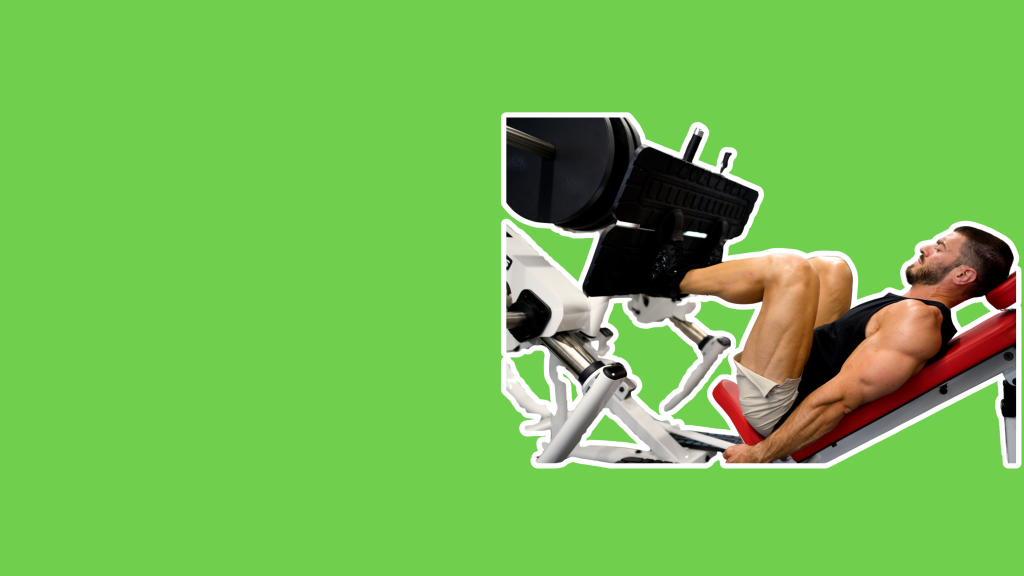
- Leg press
- Hack squat
- Pendulum squat
- Smith machine squat
- Belt squat
- Leverage squat
These movements all fall under the squat-pattern umbrella, where the client drives through a combination of knee extension and hip extension to move the load. But because these variations offer more built-in stability than free-weight squat variations, they often make it easier to create high levels of quadriceps tension without balance, bracing, or low-back fatigue becoming the limiting factor first.
Best Rep Ranges for Quad-Focused Squat Patterns
We know muscle can be built across a wide rep range — roughly 5 to 30 reps — but that doesn’t mean all rep ranges are equally effective for every exercise, especially on demanding lower-body movements.
A long, high-rep set on a hack squat or pendulum squat can get uncomfortable fast. Metabolite buildup, cardiovascular fatigue, and the sheer mental challenge of grinding through 20-plus reps can cause a client to stop the set because they feel gassed, and not because the quads have been challenged as effectively as intended. Those aren’t always the same thing.
With heavier loads around 80% of 1RM and above, high-threshold motor units are recruited much earlier in the set. The muscle experiences high tension without needing endless reps to get there. With lighter loads, the set usually has to go much closer to failure before the largest motor units are fully involved. That can work, but on demanding lower-body exercises it often comes with a higher cost.
For this reason, I generally prefer programming squat-pattern quad movements in lower to moderate rep ranges.
For most clients, that usually means somewhere around:
5–10 reps for squat-pattern quad work
This range is low enough that:
- High levels of motor unit recruitment can happen earlier in the set
- Momentary muscular failure is not necessary
- Metabolic stress remains more controlled
- Technique is easier to maintain
- The client can focus intently on force production, while ignoring other variables
This does not mean you can never use higher reps.
You can.
But if your goal is high-quality quad hypertrophy work, lower to moderate rep ranges often give you the best trade-off between tension, execution, effort, and recoverability.
Why the Rectus Femoris Needs Direct Quad Training
Squat-pattern exercises are excellent for challenging the vastus muscles: the vastus lateralis, medialis, and intermedius, which are trained well through squats, leg presses, and hack squats.
But there’s one quad muscle that deserves its own conversation: the rectus femoris.
Unlike the vasti, the rectus femoris crosses both the hip and the knee. It contributes to knee extension and hip flexion, which means its ability to produce tension depends on what’s happening at both joints simultaneously. This is exactly why squat-pattern movements don’t train it as effectively as most coaches assume. During a squat or leg press, the hip and knee are moving together, which means the rectus femoris usually does not receive the same tension stimulus as the vasti.
Squat patterns will take care of a lot, but they won’t always give the rectus femoris what it needs for the best growth potential.
Why Leg Extensions Are Effective for Quad Growth
The most direct way to train knee extension is the classic leg extension.
It has been criticized for years for not being “functional” enough, but that depends entirely on what function we are talking about.
If your client wants bigger quads, the leg extension is highly functional for that goal.
It trains knee extension directly, removes most low-back involvement, reduces stability demands, and lets your client push close to failure with a high degree of control.
Depending on the machine setup, you may also be able to lean the torso back significantly, placing the hip into more extension and increasing the stretch on the rectus femoris.
This matters because the rectus femoris crosses the hip. A more extended hip position can place it in a more lengthened position before the knee begins extending.
In other words, a leaning-back leg extension typically provides additional stretch-mediated hypertrophy outcomes more than the typical seated leg extension.
How to Use Lengthened-Biased Leg Extensions for Hypertrophy
Research continues to support training in lengthened positions as a strong driver of hypertrophy, and the leg extension is one of the easiest places to use that principle.
One option is the 1¼ rep, where the extra quarter rep is performed at the bottom of the movement before completing the full rep.
This increases time, control, and effort in the more lengthened range.
For rep ranges, leg extensions often work well in the 10–20 rep range, with an emphasis on proximity to failure, control, and consistent tension.
Because the movement is isolated and less systemically demanding, higher reps are usually more tolerable here than they are on heavy squat-pattern work.
Should You Pause at the Top of Leg Extensions?
One unique feature of most leg extension machines is that tension remains relatively high near the top of the movement, where the knee is close to full extension.
This gives you something almost no other quad-based movement can offer:
A way to challenge the quads in the fully shortened position.
There is an important nuance, though.
At full knee extension, the rectus femoris may experience some degree of active insufficiency, especially when the hip is also flexed. Active insufficiency occurs when a muscle that crosses multiple joints becomes too shortened across those joints to produce maximal force.
So, no, the top position is probably not where the rectus femoris produces maximal force.
But that does not make it useless.
If the machine provides meaningful tension there, pauses can still be valuable. Not because the top position is “better,” but because it gives you a chance to practice control, intent, and contraction quality in a range that is often hard to challenge elsewhere.
Should Leg Extensions Come Before or After Squat Patterns?
This is where things get interesting.
In many cases, performing leg extensions before squat-pattern movements does not seem to significantly impair performance on those bigger movements afterward.
But performing leg extensions after heavy squat-pattern work often leads to a noticeable drop in load selection and output.
This does not mean leg extensions must always come first.
It means exercise order should match the goal.
If I want to prioritize rectus femoris work, I may place leg extensions earlier. If I want the client fresher for heavier squat-pattern work, I may place them after.
Neither is universally correct.
The right choice depends on the client, their tolerance, their goals, and what you are trying to emphasize in that training block.
Sissy Squats and Reverse Nordics for Rectus Femoris Growth
Leg extensions are one of the simplest ways to train the rectus femoris through direct knee extension, especially when the setup allows the hip to sit in a more extended position.
But they are not the only option.
If you want to challenge the rectus femoris in a more lengthened position, sissy squats and reverse nordics become especially relevant.
Both movements place the hip in extension while the knee moves into deep flexion, creating a strong stretch across the rectus femoris.
A true sissy squat (not the hip-flexed version most people perform on the machine) maintains a straight line from the knees through the hips to the shoulders as the client descends. This creates a significant stretch across the front of the thigh and a real demand on the rectus femoris. But it also requires a meaningful degree of knee tolerance, range of motion, and control.
Don’t program sissy squats for clients who haven’t already built exposure to deep knee-flexion positions through split squats, lunges, or similar movements. And if a client has knee pain, program something else.
Even once a client can perform 8–10 reps, there is usually still room to progress through:
- Deeper lengthened positions
- Better hip extension maintenance
- Improved control
- Slight pauses in the bottom
- Eventually holding a plate or dumbbell over the chest
Load is not the only form of progression.
Better execution is still progression.
How to Program Reverse Nordics for Quad Hypertrophy
The reverse Nordic can be viewed as a regression or prerequisite to the sissy squat.
Because the reverse Nordic is performed from a kneeling position, stability demands are reduced compared to a true sissy squat. It also keeps the work more concentrated in the lengthened half of the movement. Instead of having to drive all the way back up to standing, the client returns to a tall kneeling position, which makes it easier to focus on the stretch, control, and tension through the front of the thigh.
That said, do not mistake “regression” for “easy.”
A bodyweight reverse Nordic can be extremely challenging, even for advanced lifters.
This is why band assistance can be so useful.
Using a band allows the client to:
- Control the range of motion
- Reduce the effective load
- Build tolerance gradually
- Progress over time by using less assistance
- Increase range of motion as capacity improves
For reverse Nordics, I generally like:
6–15 reps
Depending on:
- Band assistance
- Tempo
- Range of motion
- Pauses
- Client strength
- Client tolerance
Sample Quad Hypertrophy Workouts for Coaches
Here are two example lower-body workouts with a quad emphasis. Neither is a universal template. They’re simply examples of how you might structure a session when quad hypertrophy is the priority.
Workout 1
A1) Step Calf Raise — 3 x 6, 6, 10
A2) Seated Leg Curl — 3 x 8
B) Leg Extension (Leaning Back) — 3 x 15
C) Pendulum Squat — 2 x 6–8
Workout 2
A1) Sled Calf Raise — 3 x 8–10
A2) Unilateral Lying Leg Curl — 3 x 8
B) Banded Hack Squat — 3 x 8–10
C) Sissy Squat — 2 x 10
If the volume looks low, remember: the number of sets on paper doesn’t tell the whole story. Volume only means something in the context of execution quality, proximity to failure, and how much tension is actually being created in the target muscle. If the work is intentional and the effort is honest, less can absolutely be enough.
But if a client loses control as they approach failure, then adding 1–2 sets may make sense as a way to accumulate more high-quality stimulatory reps without forcing every set into technical breakdown.
Final Thoughts on Building Bigger Quads
The goal isn’t to pick one exercise and run it into the ground. It’s not to force every client into a barbell squat. It’s to understand what you’re actually trying to accomplish, choose tools that make it possible, and program those tools with enough clarity and intent that the right muscle gets the right stimulus.
For most clients, that means using squat-pattern movements to heavily load the vasti, while including direct work for the rectus femoris through leg extensions, sissy squats, and reverse Nordics.
The more clearly you understand the anatomy, the easier the programming decisions become. And the better your exercise selection, the more consistently your clients can do the one thing that actually drives quad growth: creating high tension, in the right tissue, with enough quality to force adaptation.
That’s where bigger quads come from.
SOURCES
Schoenfeld, B. J., Grgic, J., Ogborn, D., & Krieger, J. W. (2017). Strength and hypertrophy adaptations between low- vs. high-load resistance training: A systematic review and meta-analysis. Journal of Strength and Conditioning Research, 31(12), 3508–3523. https://doi.org/10.1519/JSC.0000000000002200
Lopez, P., Radaelli, R., Taaffe, D. R., Newton, R. U., Galvão, D. A., Trajano, G. S., Teodoro, J. L., Kraemer, W. J., Häkkinen, K., & Pinto, R. S. (2021). Resistance training load effects on muscle hypertrophy and strength gain: Systematic review and network meta-analysis. Medicine & Science in Sports & Exercise, 53(6), 1206–1216. https://doi.org/10.1249/MSS.0000000000002585

Responses